
1. Start with Your Kitchen Triangle
The foundation of any great modular kitchen design is the work triangle — the imaginary line connecting your refrigerator, sink, and cooktop. These three points represent your most frequent movement zones, and how you arrange them determines how tiring or effortless your cooking experience will be. The ideal work triangle has each side measuring between 4 and 9 feet, with a total perimeter not exceeding 26 feet. Too large and you are walking marathons; too compact and you bump into yourself constantly. In Interior Design terms, this principle is the first rule every professional follows before recommending a kitchen layout. Pro TipBefore finalising any layout, spend a day observing how you actually move in your current kitchen. Note where you reach most often — that spot should be your most accessible storage zone.2. Choose the Right Layout for Your Space
The shape of your kitchen directly dictates which layout will serve you best. There is no universal answer — each configuration has strengths that shine in different homes:L-Shaped Kitchen
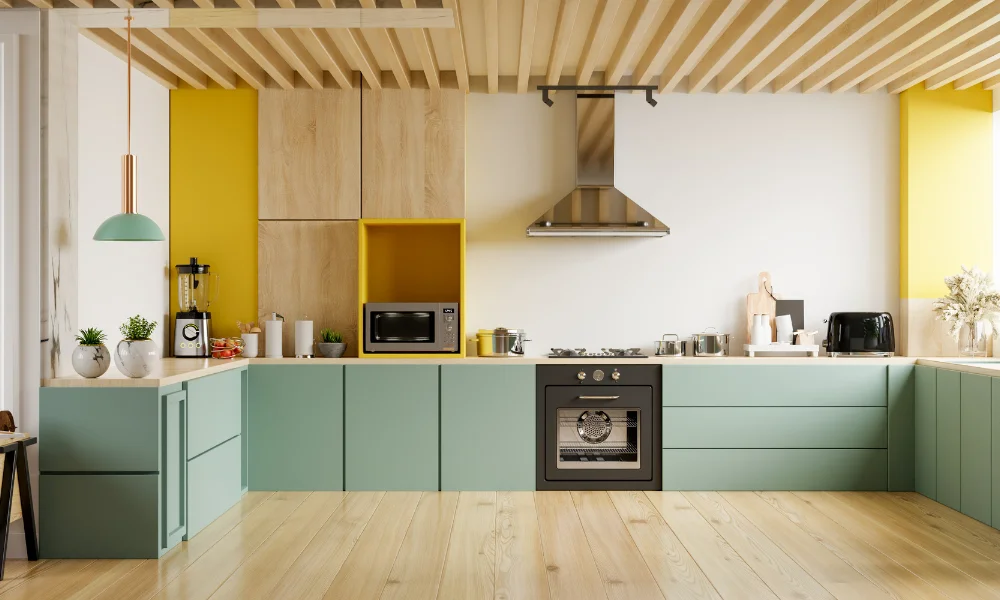
- Perfect for open-plan homes. The two-wall design keeps the work triangle tight and leaves the centre open for a kitchen island or casual dining. This is a favourite in modern Interior Design Chennai projects for 2 BHK and 3 BHK apartments, where square footage is at a premium.
U-Shaped Kitchen
- Best for serious home cooks. Three walls of cabinetry give you maximum storage and countertop space. Ideal for larger kitchens, this layout also lends itself beautifully to luxury interiors, where premium appliances, statement range hoods, and under-cabinet lighting can be incorporated without clutter.
Parallel / Galley Kitchen
- Two facing counters make for an efficient, focused workspace. Often seen in Indian homes where the kitchen is a separate enclosed room. With thoughtful modular kitchen design, even a narrow galley can feel sleek and spacious.
Straight / Single-Wall Kitchen
- Compact and minimalist. Works well for studio apartments and homes where cooking is occasional. Vertical wall storage becomes critical here to compensate for the limited counter run.
3. Master Your Storage Strategy
Amateur kitchen planning prioritises countertop space. Expert interior design prioritises storage. The most common complaint homeowners voice two years after moving in is never “I wish I had more countertop” — it is always “I have nowhere to store anything.”1 Zone your storage
- Cookware near the hob, crockery near the dining table, snacks and dry goods accessible at eye level.
2 Go vertical
- Tall pantry units from floor to ceiling double your storage without using extra floor space.
3 Use the corners
- Magic corner units, Le Mans trays, or carousel shelves transform dead corner space into functional storage.
4 Drawer-first approach
- Deep drawers for pots and pans beat base cabinets every time — everything is visible and accessible at once.
4. Select Materials That Last and Look Stunning
The materials you choose for your modular kitchen need to balance durability, maintenance ease, and visual appeal. The Indian climate — particularly in coastal cities — adds humidity and temperature variation to the equation, making this decision even more critical.Cabinet Shutters
Acrylic: High-gloss, scratch-resistant, and easy to clean. A top choice for modern luxury interiors — the reflective surface makes small kitchens feel larger. PU-painted MDF: Smooth matte finish with incredible colour range. Elegant, premium, and the go-to finish for sophisticated interior design Chennai projects. Laminate: Most cost-effective and versatile. Modern digital laminates convincingly replicate wood, stone, and metal textures.Countertops
Engineered quartz remains the undisputed leader for Indian kitchens — non-porous, heat tolerant to a reasonable degree, and available in colours that complement any style. Granite offers extreme durability and is particularly popular in Interior Design Chennai projects for its resistance to South Indian cooking styles that involve intense heat and turmeric stains. For a truly luxurious upgrade, Calacatta marble or its quartz equivalent adds unparalleled elegance — but requires mindful use.Cabinet Box Material
This is where many homeowners unknowingly cut corners. Always insist on pre-laminated or BWP (Boiling Water Proof) plywood or HDF boards for the internal carcass. In humid climates, the wrong board material leads to warping, swelling, and complete cabinet failure within five years — regardless of how beautiful the exterior finish looks.5. Light It Like a Professional
Lighting is the single most underestimated element in modular kitchen planning. Most homeowners budget for one ceiling light and call it done. Every serious interior design approach uses a three-layer lighting strategy: Ambient lighting — General illumination from recessed ceiling lights or flush mounts that fill the room evenly. Task lighting — Under-cabinet LED strips directed at countertops, eliminating the shadows cast by your own body while you work. This is non-negotiable in a functional kitchen. Accent lighting — Inside glass-fronted cabinets, above open shelves, or toe-kick lighting beneath base units. This is where luxury interiors distinguish themselves — warm accent lights at dusk transform a kitchen into an atmospheric, inviting space. Expert Insight In modern interior design Chennai projects, pendant lights above a kitchen island or breakfast counter have become a signature design move — they add visual height, warmth, and a curated, bespoke feel that no overhead light can replicate.6. Plan Your Appliances Early — Not as an Afterthought
One of the costliest mistakes in modular kitchen planning is selecting appliances after the cabinets are built. Appliance dimensions directly influence cabinet heights, cut-out sizes, ventilation clearances, and electrical point locations. Changes at this stage are expensive and disruptive. Work with your interior design professional to finalise your appliance list — chimney, hob, oven, microwave, dishwasher, refrigerator — before a single module is ordered. Built-in appliances that sit flush with cabinetry are a hallmark of contemporary luxury interiors, and they require precise coordination between appliance specs and cabinet dimensions from day one.7. Ventilation — The Detail That Protects Your Investment
India’s cooking culture — with its rich use of spices, deep frying, and long simmering — produces significantly more grease and moisture than Western-style cooking. Without adequate ventilation, this accumulation damages cabinet finishes, discolours walls, and creates persistent odour problems. Choose a chimney with a suction capacity of at least 1200 m³/hour for Indian cooking. For luxury interiors, architectural-style chimneys with concealed motors and island hoods can become striking focal points rather than purely functional elements. Ducted installation is always preferred over recirculating — it removes smoke and grease entirely rather than filtering and recirculating it.8. Colour, Texture & the Finishing Details
A modular kitchen that functions perfectly but looks uninspiring is a missed opportunity. The finishing details — colour palette, texture combinations, hardware, and open shelving — are where a kitchen transforms from well-designed to deeply personal. In contemporary interior design Chennai, the most popular kitchen aesthetics blend warm neutrals (linen, warm white, stone) with natural wood tones for warmth and depth. Two-tone kitchens — darker lower cabinets grounding the space, lighter uppers keeping it airy — have overtaken all-white designs as the preferred approach for luxury interiors. Open shelves in one section add lightness and create space for personalised display — curated ceramics, copper cookware, potted herbs — turning the kitchen into a reflection of who you are. Matte black or brushed brass hardware elevates even mid-range cabinet finishes to a premium appearance.FAQs
1. How much does a modular kitchen cost in Chennai?
The cost of a modular kitchen in Chennai typically ranges from ₹1.5 lakh to ₹10 lakh or more, depending on the size, materials, and finish. Luxury interiors with premium quartz countertops and PU-painted shutters will be on the higher end.
2. What is the best layout for a small modular kitchen?
An L-shaped or straight single-wall layout works best for compact kitchens. A skilled interior design professional can maximise vertical storage and smart modular units to make even a small kitchen highly functional.
3. How long does it take to install a modular kitchen?
A standard modular kitchen installation in Chennai takes 7 to 15 working days, depending on the complexity of the design, number of modules, and appliance integration involved.
4. Which material is best for modular kitchen cabinets in Chennai?
BWP (Boiling Water Proof) plywood or HDF boards with acrylic or PU-painted shutters are ideal for Chennai’s humid climate. These materials resist moisture, warping, and are widely recommended by interior design Chennai experts.
5. Can a modular kitchen be customised for Indian-style cooking?
Absolutely. A well-planned modular kitchen can be customised with a high-suction chimney, deep drawers for heavy cookware, heat-resistant countertops, and dedicated masala and oil storage — perfectly suited to Indian cooking needs.
