
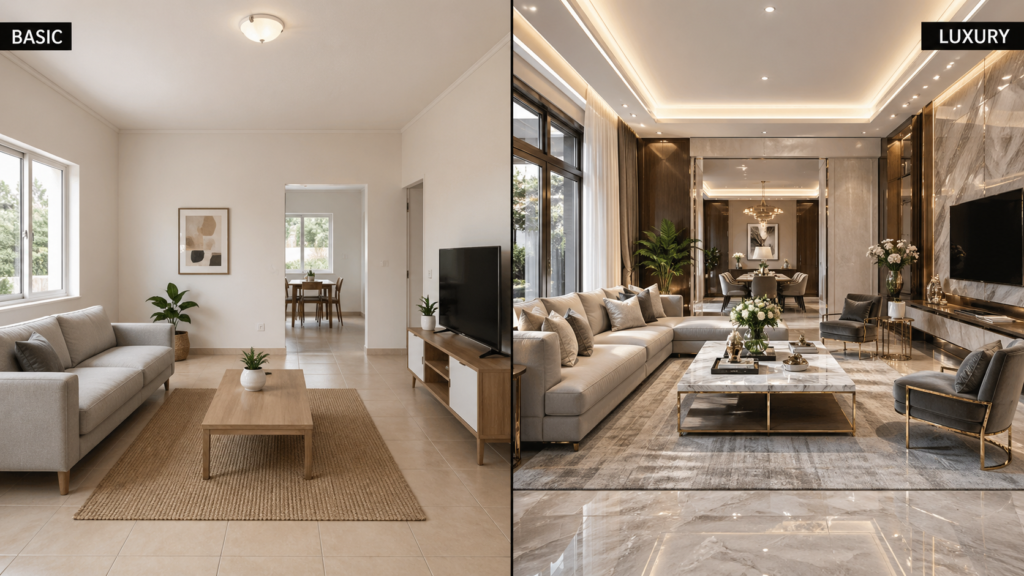
Walk into two homes. Both are clean, furnished, and decorated. One feels pleasant. The other stops you mid-step — you can’t immediately explain why, but something about it feels elevated, considered, and quietly extraordinary. That invisible gap between “nice” and “remarkable” is exactly what separates basic home design from high-end home design.
It isn’t always about budget. It isn’t always about brand names. And it certainly isn’t about filling every corner with expensive objects. The real difference lies in decisions — the ones most homeowners never think to make, and the ones that professional home interior make instinctively.
This blog unpacks those decisions, layer by layer, so you understand what truly elevates a living space from ordinary to outstanding.
The Foundation: Intention vs. Impulse
The most fundamental difference between basic and high-end home interior design is this: one is driven by impulse, the other by intention.
Basic design often happens reactively. A sofa is chosen because it’s on sale. A paint colour is selected because it looked good on a neighbour’s wall. A light fixture is picked because it was available in stock. Each decision is made in isolation, with no overarching vision connecting them.
High-end home interior design begins with a concept — a clearly defined visual language, a mood, a lifestyle aspiration. Every single element, from the door handles to the ceiling detail to the gap between cushions, is chosen in service of that concept.
This is precisely why the Best interior designers in Chennai spend the first phase of any project not drawing floor plans or selecting tiles, but understanding how a family lives, what they value, and how they want to feel inside their home.
Intent is the foundation. Everything else is built on top of it.
Space Planning: The Invisible Architecture
You could furnish a room with pieces from the most premium brands in the world and it will still feel wrong if the space planning is off. Conversely, a thoughtfully planned room with mid-range furniture can feel genuinely luxurious.
Basic design approaches space reactively — furniture is placed where it fits, traffic flows where it can, and storage is added only when the lack of it becomes a problem.
High-end home interior design treats space as a living, breathing architecture. Professional interiors designers think about:
- Sight lines — what you see the moment you enter a room
- Traffic flow — how people move through the space without disruption
- Furniture proportion — whether each piece is scaled correctly for the room’s dimensions
- Negative space — the deliberate emptiness that allows a room to breathe
- Zoning — how a single open-plan area is divided into distinct functional pockets without physical walls
The Best interior designers in Chennai apply these principles to every project, whether it’s a compact 2BHK apartment or a sprawling independent villa. The discipline of space planning doesn’t change based on budget — it changes based on skill.
Materials: The Difference Between Looking Good and Feeling Good
Photography has created a dangerous illusion. A laminate surface can look nearly identical to real wood veneer in a carefully lit photograph. A printed wallpaper can mimic hand-applied Venetian plaster almost perfectly on Instagram. Basic design often exploits this — achieving a visual impression of luxury while using materials that degrade quickly, feel hollow underfoot, or look dated within five years.
High-end design prioritises how materials feel, not just how they photograph.
Consider the difference in:
- Flooring — basic vinyl flooring versus Italian marble or engineered hardwood with a micro-bevel edge
- Wall treatments — standard paint versus textured microcement, grasscloth wallcovering, or hand-applied lime wash
- Cabinetry — basic MDF with foil finish versus solid wood with dovetail joinery and soft-close German hardware
- Upholstery — polyester blends versus performance linen, genuine leather, or hand-loomed fabric
Nowhere is this material difference more visible — and more consequential — than in the kitchen. A Modular Kitchen using imported quartz countertops, solid aluminium profiles, Hettich or Blum hardware, and lacquered cabinet finishes will look, feel, and perform completely differently from one assembled with low-grade particleboard and basic hinges.
The Best interior designers in Chennai have deep material knowledge and trade relationships that allow them to source premium finishes — often at prices unavailable to the general public. This access alone justifies their involvement in any Modular Kitchen project.
Lighting: The Most Underestimated Design Element
Ask any experienced interiors designers what separates average spaces from extraordinary ones and almost every answer will include lighting.
Basic home design treats lighting as a utility — one overhead light per room, perhaps a bedside lamp, and the project is complete. The result is flat, uninspiring illumination that washes everything in the same quality of light regardless of time of day or activity.
High-end home interior design approaches lighting as architecture — layered, intentional, and capable of completely transforming a space:
- Ambient lighting sets the overall tone and brightness
- Task lighting focuses on work surfaces — critical in a Modular Kitchen, study area, or dressing room
- Accent lighting highlights artwork, architectural features, or textures
- Decorative lighting — chandeliers, pendants, wall sconces — adds sculptural drama
The best lighting plans also incorporate circadian rhythm thinking — warm tones in the evening that encourage relaxation, cooler daylight tones in work spaces that promote focus.
Dimmers, smart lighting controls, and carefully positioned cove lighting can make the same room feel completely different at 7am versus 7pm. This level of nuance is invisible in basic design and central to premium home interior design.
The Modular Kitchen: Where Luxury Is Built In
The kitchen has evolved from a functional back-of-house space into the emotional heart of the modern Indian home. A well-designed Modular Kitchen is now one of the clearest indicators of overall design quality — and one of the biggest differentiators between basic and high-end home interior design.
At a basic level, a Modular Kitchen delivers storage and a cooking surface. At a high-end level, it delivers:
- Custom cabinetry sized to your ceiling height, not limited to standard module dimensions
- Integrated appliances that disappear behind cabinet panels for a seamless visual flow
- Pull-out systems and organisers — drawer dividers, carousel units, magic corners — that make every centimetre functional
- Premium countertop materials — Calacatta quartz, Neolith sintered stone, or honed granite — that are both beautiful and highly durable
- Under-cabinet and in-cabinet lighting that makes the space both safer and more atmospheric
- Statement hardware — recessed handles, leather pulls, or brushed brass knobs — that add a bespoke quality
When the Best interior designers in Chennai plan a Modular Kitchen, they begin not with the cabinets but with the workflow — how the homeowner cooks, what appliances they use daily, how many people typically move through the kitchen simultaneously. The design follows function, and luxury is the result of both being perfectly aligned.
Custom vs. Off-the-Shelf: The Bespoke Advantage
Basic design relies heavily on off-the-shelf furniture and standard solutions — items that exist in catalogues and arrive in flat-pack boxes. There is nothing inherently wrong with this. Many mass-market furniture pieces are well-made and well-designed. But they are, by definition, generic.
High-end home interior design introduces bespoke elements — pieces designed specifically for the space, the client, and the concept.
This could mean:
- A dining table built to a specific length that fits the dining room without crowding it
- A built-in wardrobe that reaches the full ceiling height and uses every centimetre of an awkward alcove
- A window seat with integrated storage, custom upholstered in a fabric chosen to echo the room’s colour palette
- A headboard designed as a full architectural wall element rather than a standalone piece
Professional interiors designers know how to mix bespoke carpentry with carefully selected ready-made pieces — achieving a curated, one-of-a-kind look without making every element custom and blowing the budget.
Texture, Layering, and the Art of Visual Depth
Scroll through the portfolio of any of the Best interior designers in Chennai and you’ll notice something consistent in the best projects: layering. There is always more happening than a single surface, a single colour, or a single material.
Basic design tends to be visually flat — one paint colour on the walls, one type of flooring, furniture that matches too perfectly. The result is a room that is coordinated but lifeless.
High-end home interior design creates depth through deliberate contrast and layering:
- Rough stone against smooth linen
- Matte walls against glossy cabinet fronts
- Warm wood tones against cool metal accents
- Geometric rugs beneath organic-shaped furniture
This layering extends to soft furnishings — cushions in varying textures, throws that add weight and warmth, curtains that pool slightly on the floor for a sense of luxury. None of these details are accidental. They are choreographed by skilled interiors designers who understand that the eye needs variation to find a space interesting.
Attention to the Finishing Details
High-end design lives and dies in the details that most people never consciously notice but always subconsciously feel.
- Are the skirting boards and architraves consistent and perfectly mitred?
- Are the electrical switches aligned and at the same height throughout the home?
- Does the grout on the tile work match the tile tone, or does it create a distracting grid?
- Are curtain tracks concealed behind a pelmet so fabric appears to fall from the ceiling?
- Is the cable management in the entertainment unit completely hidden?
Basic design rarely sweats these details. High-end design is obsessed with them. The Best interior designers in Chennai conduct detailed site inspections specifically to catch and correct these finishing imperfections before the client walks in.
The Long-Term Value of Investing in Quality Design
Basic design often looks acceptable for two to three years before the wear begins to show — peeling laminates, fading upholstery, hardware that loosens and squeaks, tiles that chip. High-end home interior design, executed with quality materials and skilled craftsmanship, ages gracefully. It remains beautiful, functional, and relevant for a decade or longer.
When you factor in the cost of replacement and renovation cycles, the economics of investing in quality interiors designers and premium materials often work out in the homeowner’s favour over time.
Beyond finances, there’s something more important — the daily experience of living in a home that was designed with genuine care. That feeling is priceless, and it is available to anyone willing to approach their home interior design with intention, patience, and the right professional partner.
The real difference between basic and high-end home design isn’t a price tag. It’s the presence — or absence — of intentional decision-making at every level: space planning, material selection, lighting design, bespoke detailing, and the invisible finishing touches that make a space feel complete.
If you’re ready to experience the difference, start by consulting the Best interior designers in Chennai — professionals who bring the expertise, the relationships, and the creative vision to transform your home interior from a place you live into a space you love.
FAQs
1. What makes high-end home design different from basic design?
High-end design uses premium materials, custom furniture, and skilled interiors designers who focus on every detail — not just surface appearance.
2. Is hiring the Best interior designers in Chennai worth the cost?
Yes — professional interiors designers prevent costly mistakes, source better materials at trade prices, and deliver results that genuinely last.
3. Can a Modular Kitchen be part of a high-end home interior?
Absolutely — a premium Modular Kitchen with custom finishes, quality hardware, and smart storage is a hallmark of high-end home interior design.
4. How do I know if my home interior is truly high-end or just expensive?
High-end home interior design feels cohesive, functional, and timeless — not just costly; true quality shows in craftsmanship, not price tags alone.
5. Do interiors designers offer both basic and high-end design packages?
Most professional interiors designers offer tiered packages, allowing homeowners to upgrade selectively — starting with key spaces like the Modular Kitchen or living area.
